Facts about Bulgaria

Bulgarian folk music is said to have inspired modern western musicians such as Kate Bush and George Harrison.

The Bulgarian judicial system consists of regional, district and appeal courts, as well as a Supreme Court of Cassation.

Bulgaria’s higher education system was fully reorganized in the mid-1990s.

In Bulgaria, the results of the treaty are popularly known as the Second National Catastrophe.
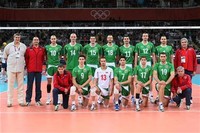
The Bulgarian men's national volleyball team is one of the strongest teams in Europe, ranked fifth in the FIVB ranklist.

The Second Bulgarian Empire in the fourteenth century brought another literary flowering with Patriarch Evtimiy, who founded the Tarnovo Literary School that influenced the literature of Serbia and Muscovite Russia.

Elections in March 1920 gave the Agrarians a large majority, and Agrarian Party leader Aleksandur Stamboliyski formed Bulgaria's first genuinely democratic government.

The poet Pencho Slaveykov brought other European literatures to the notice of Bulgarian readers.

The Romanian army and a small contingent of Bulgarian exiles also fought alongside the advancing Russians.

Following a series of reductions beginning in 1989, the active troops of Bulgaria's army number as many as 68,450.

Most Bulgarians (82.6 percent) are, at least nominally, members of the Bulgarian Orthodox Church, the national Eastern Orthodox Church.
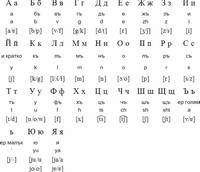
Much vocabulary has been borrowed from Russian, Greek, and Turkish, and the latter two have influenced Bulgarian grammar.
After the Second World War, Bulgarian literature fell under the control of the Communist Party and, particularly in the early years, was required to conform to the Stalinist style called "socialist realism."

The president of Bulgaria is directly elected for a five-year term with the right to one re-election.

A literary tradition continued during the early Ottoman rule in northwestern Bulgaria up to the end of the seventeenth century among Bulgarian Catholics, who were supported by the Catholic states of Central Europe.

The Bulgarian unicameral parliament, the National Assembly or Narodno Sabranie, consists of 240 deputies who are elected to four-year terms by popular vote.
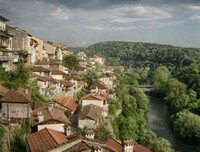
Hilly country and plains are found in the southeast, along the Bulgarian Black Sea coast in the east, and along the Danube river in the north.

The freedom of religion and the religious equality are included in the Constitution of Bulgaria as inalienable rights of every citizen.

Bulgaria is becoming an attractive destination because of the quality of the resorts and prices below those found in Western Europe.

Thracians, a group of ancient Indo-European peoples who spoke the Thracian language, were the earliest known people to inhabit what is now Bulgaria and are direct ancestors of the modern Bulgarian nation.

Certain entrйes, salads, soups and dishes go well with alcoholic beverages and the alcohol of choice for some is Bulgarian wine.
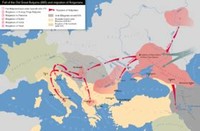
Pressure by the Khazars led to the loss of the eastern part of Great Bulgaria in the second half of the seventh century.

In 1870, a Bulgarian Exarchate was created by a sultan's edict, and the first Bulgarian Exarch (Antim I) became the natural leader of the emerging nation.


Ferdinand, a prince from the ducal family of Saxe-Coburg-Gotha, became the Bulgarian prince after Alexander von Battenberg abdicated in 1886 following a coup d'йtat staged by pro-Russian army officers.

The Gradeshnitsa Tablets, discovered in southern Bulgaria, appear to point to Bulgaria as home of one of the world's oldest known writing systems, preceding the Sumerian and Egyptian hieroglyphics by nearly two millennia.


Bulgaria is rich in non-metalliferous minerals such as rock salt, gypsum, kaolin, and marble.

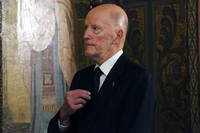
On June 17, 2001, Simeon Saxe-Coburg-Gotha, the son of Tsar Boris III and head of state as the tsar of Bulgaria from 1943 to 1946, won a narrow victory.

In 717, Bulgarians stopped the Arab siege of Constantinople, killing some 40,000-60,000 Arab soldiers, earning Bulgarian Khan Tervel a reputation as "The Savior of Europe."

In April 1876, the Bulgarians revolted in the so-called “April Uprising.” The revolt was poorly organized, started before the planned date, and was largely confined to the region of Plovdiv.
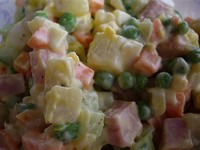
Bulgarian cuisine is essentially Slavic, but shows Turkish, Greek and Middle Eastern influences, as well as Armenian, Italian, Mediterranean and Hungarian ones.
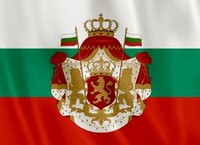
Bulgarian nationalism emerged in the early nineteenth century under the influence of western ideas of liberalism and nationalism that trickled into the country after the French Revolution, mostly via Greece.

In 1185, the Second Bulgarian Empire once again established Bulgaria as an important power in Europe for two more centuries.
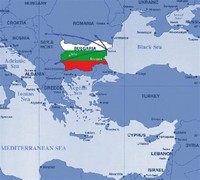
Bulgaria's strategic location, highly-qualified workforce, and good education make it an attractive location for multinational companies.

The tsar's regime banned all opposition parties and took Bulgaria into alliance with Nazi Germany and Fascist Italy.
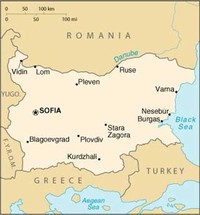
Bulgarian, the mother language of 84.8 percent of the population, is a South Slavic language of the Indo-European language family.

Greek mythological figure Orpheus, the "father of songs," is said to be from Thrace, a region partly in Bulgaria.

Bulgaria's population was 7,679,290 in 2007, a decline of 1.5 million since 1989.

In 1912 and 1913, Bulgaria became involved in the Balkan Wars, entering into conflict with Greece and Serbia against the Ottoman Empire.

Resistance continued under Tsar Samuil in the western Bulgarian lands for nearly half a century until the state was destroyed by the Byzantines led by Basil II in 1018.

In 1991 Bulgarian environmentalists estimated that 60 percent of the country's agricultural land was damaged by excessive use of pesticides and fertilizers and by industrial fallout.

During World War II, Nazi Germany allowed Bulgaria to occupy parts of Greece and Yugoslavia, including territories long coveted by the Bulgarians.

The Military of Bulgaria comprises the Bulgarian land forces, Bulgarian Navy and Bulgarian Air Force.

Bulgarian is the only official language, and is the language of instruction in schools, but other languages such as Turkish and Romany are spoken as well.

Bulgaria comprises portions of the classical regions of Thrace, Moesia, and Macedonia.

In 1991, two thirds of Bulgarian rivers were polluted, and the Yantra River was classified as the dirtiest river in Europe.

During the Ottoman rule of the Balkans, Islam established itself in Bulgaria, while Roman Catholicism has roots in the country since the Middle Ages, and Protestantism arrived in the nineteenth century.

Bulgarians marry by individual choice, although families may exert pressure on the choice of spouse.
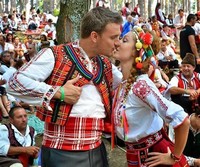
The greatest success of the Bulgariam national football team was a fourth-place finish at the 1994 FIFA World Cup in the United States.

Ownership of agricultural land and forests is restricted to Bulgarian citizens, government entities, and organizations.

Sofia is the capital and largest city of Bulgaria, with a population of 1,246,791 (making it the fifteenth-largest city in the European Union).

After the Serbo-Bulgarian War and unification with Eastern Rumelia in 1885, the principality was proclaimed a fully independent kingdom in October 1908, during the reign of Ferdinand I of Bulgaria.


Countless villages were pillaged and tens of thousands of people were massacred, the majority of them in the insurgents' towns of Batak, Bulgaria, Perushtitsa and Bratsigovo in the area of Plovdiv.

Philip Koutev, an influential musician of twentieth-century Bulgaria, updated rural music with more accessible harmonies.

During the reign of Boris I, Bulgaria produced the Slavonic alphabet, which became a pillar for further cultural development.

Some Bulgars from that territory later migrated to the northeast to form a new state called Volga Bulgaria around the confluence of the Volga River and Kama River, which lasted the thirteenth century.

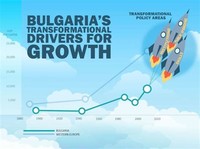
Bulgaria has enjoyed a substantial growth in income from international tourism over the past decade.


Ethnic Bulgarians value education and children are encouraged to do well, with many parents paying for private tutoring to ensure that their children pass entrance examinations for the better secondary schools.

The Ottomans reorganized the Bulgarian territories as the Beyerlik of Rumelia, ruled by a Beylerbey at Sofia.

In 2003 Bulgaria’s literacy rate was estimated at 98.6 percent, with approximately the same rate for both sexes.

During his reign, Bulgaria developed a rich, unique Christian Slavonic culture, which became an example for the other Slavonic peoples in Eastern Europe and ensured the continued existence of the Bulgarian nation.

The massacres aroused a broad public reaction led by liberal Europeans such as William Gladstone, who launched a campaign against the "Bulgarian Horrors."
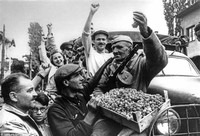
From 1944-1989, the country was known as the "People's Republic of Bulgaria" (PRB) and was ruled by the Bulgarian Communist Party (BCP).

According to the 2001 census, Bulgaria's population is mainly ethnic Bulgarian (83.9 percent), with two sizable minorities, Turks (9.4 percent) and Roma (4.7 percent).

In 1944, Bulgaria's forces were turned against its former German ally (a 450,000 strong army in 1944, reduced to 130,000 in 1945).
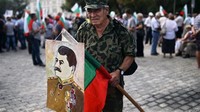

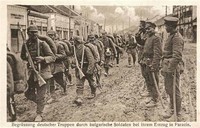
During World War I, Bulgaria found itself fighting on the losing side after its alliance with the Central Powers.

Bulgarian folk music is unique in its complex harmonies and highly irregular rhythms.

The politics of Bulgaria take place in a framework of a parliamentary representative democratic republic, whereby the minister-chairman is the head of government, and of a pluriform multi-party system.

Bulgaria was a major supplier of scientific and research instruments for the Soviet space programs, was the first European country to develop serial computer production, and has experience in pharmaceutical research and development.

A typical feature of the period was the formation of an interest in Bulgarian folklore, as figures like the Miladinov Brothers and Kuzman Shapkarev made collections of folk songs and made ethnographic studies.
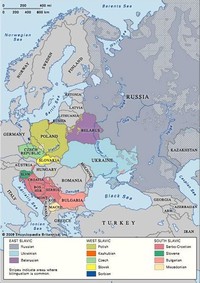

Parliament enacts laws, approves the budget, schedules presidential elections, selects and dismisses the prime minister and other ministers, declares war, deploys of troops outside of Bulgaria, and ratifies international treaties and agreements.

Bulgarian military personnel have been involved in international missions in Cambodia, Bosnia and Herzegovina, Kosovo, Afghanistan and Iraq.

After Bulgaria achieved independence (1878) the national literature lost much of its revolutionary spirit, and writings of a pastoral and regional type became more common.

The land area of Bulgaria is 42,823 square miles (110,550 square kilometers), slightly larger than that of Iceland or the state of Tennessee.

Bulgarian literature began in the late ninth century C.E., when numerous religious books were translated from Byzantine Greek.

Bulgaria has been a traditionally Christian state since the adoption of Christianity in 865, with the dominant confession being Eastern Orthodoxy of the Bulgarian Orthodox Church.

After being defeated in the Second Balkan War, Bulgaria lost most of the territory conquered in the first war, as well as Southern Dobruja.
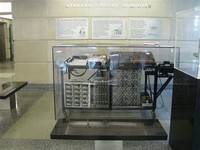
The inventor of the earliest known electronic computer, John Atanasoff, is of Bulgarian descent.

More than 30,000 Bulgarian soldiers and officers were killed in the war.

Many Bulgarian fans follow the Bulgarian "A" Professional Football Group, as well as the leagues of other European countries.
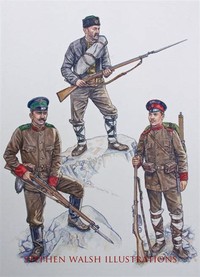
The campaign was a success for the Bulgarian army, but unfortunately the allies clashed over the division of Macedonia.

The noted poet and revolutionary Hristo Botev worked in the late nineteenth century and is regarded as arguably the foremost Bulgarian poet of the period.

The Greek revolt against the Ottomans, which began in 1821, influenced the small Bulgarian educated class.

Following the Russo-Turkish War (1877-1878) and after the Treaty of San Stefano of March 3, 1878, an autonomous Bulgarian principality was proclaimed.

Perhaps the most serious environmental problem in Bulgaria was in the Danube port city of Rousse.

Vasil Levski (1837–1873) was a Bulgarian revolutionary, ideologist, strategist and theoretician of the Bulgarian national revolution.
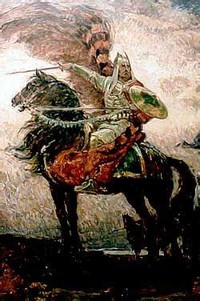
The peace treaty with Byzantium in 681 and the establishment of the new capital of Pliska south of the Danube is considered the beginning of the First Bulgarian Empire.
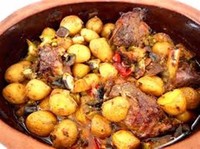
Bulgarian cuisine features also a variety of hot and cold soups, an example of a cold soup being tarator.

Bulgarians dominate weightlifting, with around one thousand gold medals in different competitions, and wrestling.

The president serves as the head of state and commander in chief of the armed forces, schedules elections and referenda, represents Bulgaria abroad, concludes international treaties, and heads the Consultative Council for National Security.

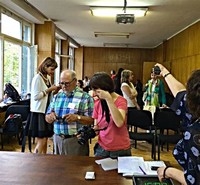
At the end of 2005, both men's and women's world chess champions were Bulgarian as well as the junior world champion.

The Bulgarian Academy of Sciences is the leading scientific institution in the country with most of the researchers working for its numerous branches.

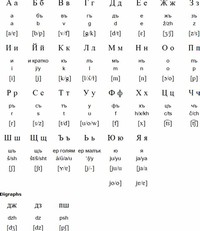
Bulgaria is also the birthplace of the Cyrillic alphabet, the second most widely used alphabet in the world, which was developed in these two schools in the tenth century.

The Constantinople Patriarch reacted by excommunicating the Bulgarian Exarchate, which reinforced their will for independence.

One of the top chess-masters in the world, Veselin Topalov, is Bulgarian.
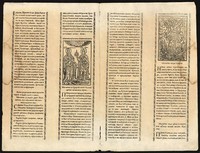
Abagar, a breviary by the Bulgarian Roman Catholic Bishop of Nikopol, Filip Stanislavov, was printed in Rome in 1651, and is regarded as the first printed Bulgarian book.

Bulgarians gave multiple regularly paid taxes as a tithe or various type of tax.

Two especially sensitive areas are in the Gorna Oryahovitsa area in north-central Bulgaria, and a wide area extending through the Rila and northern Pirin regions to Plovdiv in south-central Bulgaria.

The barrier effect of the east-west Balkan Mountains is felt throughout the country: Northern Bulgaria is slightly cooler and receives more rain than the southern regions.

In 864, Bulgaria accepted the Orthodox Faith, and became a European power in the ninth and the tenth century, while fighting the Byzantine Empire for control of the Balkans.

Bulgarian scholars and works spread Old Church Slavonic, the Cyrillic and the Glagolithic alphabet to Kievan Rus, Serbia and Croatia.
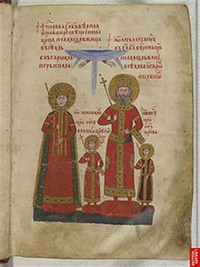
The Bulgars merged with the local Romanized and Hellenized Thracian and Slavic inhabitants in the late seventh century to form the first Bulgarian state.
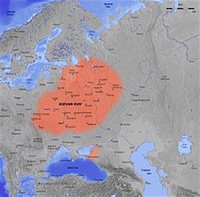
Following a decline in the mid tenth century, worn out by the wars with Croatia and frequent Serbian rebellions sponsored by Byzantine gold, Bulgaria was crushed by an assault of the Kievan Rus in 969.

Bulgarian vocal style has a unique throat quality, while the singers themselves are renowned for their range.

In 2003 some 4.9 percent of Bulgaria’s national budget was devoted to education.
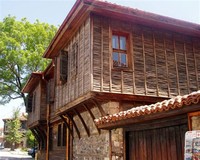
Bulgarian Revival and early modern literature continues to form the core of literature studies within the Bulgarian education system.
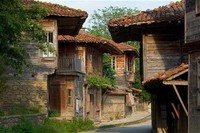
Bulgarian literature revived in the eighteenth century with the historiographical writings of Paisius of Hilendar, Istoriya Slavyanobolgarskaya.

Ethnic Bulgarians descend from the merging of Bulgars, a central Asian Turkic people, and Slavs, a central European people, beginning in the seventh century C.E.
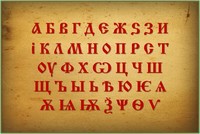
Centuries later, this alphabet along with the Old Bulgarian language became the intellectual written language (lingua franca) for Eastern Europe.

The Balkan Wars and World War I led to the influx of over 250,000 Bulgarian refugees from Macedonia, Eastern and Western Thrace and Southern Dobruja.

After regaining power near the end of Reconstruction, the Democratic Party maintained a monolithic political presence in Texas until the late twentieth century.

Owing to the relatively warm climate and diverse geography affording excellent growth conditions for a variety of vegetables, herbs and fruits, Bulgarian cuisine is particularly diverse.

Sixteen major earthquakes struck Bulgaria between 1900 and 1986, the last two in Strazhitsa on the Skopje-Razgrad fault line.

The greatest territorial extension was reached under Simeon I of Bulgaria, the first tsar, son of Boris I, covering most of the Balkans.
Bulgarian food is tasty, fresh and hearty. Bulgaria is famous for its quality vegetables and dairy products and its variety of mild spices. Pork and chicken are the most common forms of meat, though seafood, fish and veal dishes are also popular and lamb has a special traditional place in Bulgarian cooking.Mar 11, 2014
The main religion in Bulgaria is Bulgarian Orthodox. There are also Roman Catholics, Muslims, Protestants, Jews etc. Around twelve percent of the people are Muslim.
Bulgaria is still ranked as part of "Emerging and Developing Europe" in IMF's recent World Economic Outlook report, though so are other EU member states from Eastern Europe, including Poland, Romania, Hungary, and Croatia.Apr 20, 2015
It is the most common second language in the Sofia, where a wide range of facilities are available for English-speaking expats. Some people may also speak German or French. Until 1989, all Bulgarian children had to learn Russian in school, though many people chose not to speak it in public.
In Bulgarian, Macedonian, Russian, and Serbian, the Cyrillic script is also known as azbuka, derived from the old names of the first two letters of most Cyrillic alphabets (just as the term alphabet came from the first two Greek letters alpha and beta).
Bulgaria has an embassy in Moscow and three consulates general (in Saint Petersburg, Novosibirsk and Yekaterinburg). Russia has an embassy in Sofia and two consulates general (in Ruse and Varna). Both countries are Slavic nations, and are bound together by a common Orthodox culture.