Top Ten Conquerors

Sargon of Akkad (Akkadian Šarru-ukīn or Šarru-kēn, also known as Sargon the Great) was the first ruler of the Semitic-speaking Akkadian Empire, known for his conquests of the Sumerian city-states in the 24th to 23rd centuries BC.

Napoleon is the greatest conqueror the world has ever seen. He defeated all the major powers of Europe, and utterly destroyed the Holy Roman Empire. Napoleon had a long and glorious reign in which he lost no major battles until he was deposed.

Without a doubt, the greatest conqueror in history, who conquered more than double the area of land that Alexander the Great did, is often one of the most forgotten conquerors in the minds of people of the western world.
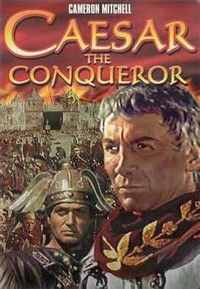
Roman Empire: Julius Caesar and the Roman army Learn how Julius Caesar and the Roman army created an empire. Contunico © ZDF Enterprises GmbH, Mainz; Caesar changed the course of the history of the Greco-Roman world decisively and irreversibly.

Cyrus the Great, also called Cyrus II, (born 590–580 bce, Media, or Persis [now in Iran]—died c. 529, Asia), conqueror who founded the Achaemenian empire, centred on Persia and comprising the Near East from the Aegean Sea eastward to the Indus River.
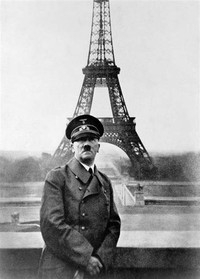
Adolf Hitler was the leader of Nazi Germany from 1934 to 1945. He initiated fascist policies that led to World War II and the deaths of at least 11 million people, including the mass murder of an estimated 6 million Jews.

Mehmed II, byname Mehmed Fatih (Turkish: Mehmed the Conqueror), (born March 30, 1432, Adrianople, Thrace, Ottoman Empire—died May 3, 1481, Hunkârçayırı, near Maltepe, near Constantinople), Ottoman sultan from 1444 to 1446 and from 1451 to 1481.

Following Hari Singh Nalwa's death, his sons Jawahir Singh Nalwa and Arjan Singh Nalwa fought against the British to protect the sovereignty of the Kingdom of the Sikhs, with the former being noted for his defence in the Battle of Chillianwala.
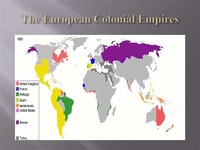
The French colonial empire constituted the overseas colonies, protectorates and mandate territories that came under French rule from the 16th century onward.

The Mongol Empire developed in the course of the 13th century through a series of conquests and invasions throughout Asia, reaching Eastern Europe by the 1240s. In contrast with later empires such as the British, which can be defined as "empires of the sea", the Mongol empire was an empire of the land, a tellurocracy, fuelled by the grass supporting Mongol cavalry and cattle.
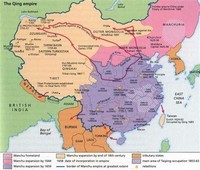
The Qing dynasty (English: / tʃ ɪ ŋ /), also known as the Qing Empire, officially the Great Qing, was the last imperial dynasty of China, established in 1636 and ruling China from 1644 to 1912. It was preceded by the Ming dynasty and succeeded by the Republic of China.
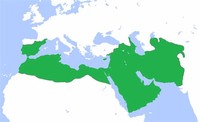
The Umayyad conquest of Hispania was the initial expansion of the Umayyad Caliphate over Hispania, largely extending from 711 to 788. The conquest resulted in the destruction of the Visigothic Kingdom and the establishment of the independent Emirate of Córdoba under Abd ar-Rahman I, who completed the unification of Muslim-ruled Iberia, or al-Andalus (756–788).

Since the fall of Rome, there has been no empire based in Europe which extends outside the continent. This situation changes abruptly in the 16th century, when Spain and Portugal become the pioneers in a new era of colonization.

Sargon of Akkad is one of the greatest conquerors mainly because he is the first known emperor to ever live. He created the world’s first empire which was the Akkadian empire. It stretched from the Mediterranean sea to the Persian Golf. Sargon is one of the most mysterious conquerors in history, he over 4000 years ago in 2000 BC.
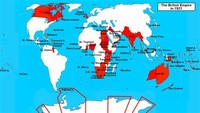
By 1913, the British Empire held sway over 412 million people, 23% of the world population at the time, and by 1920, it covered 35,500,000 km 2 (13,700,000 sq mi), 24% of the Earth's total land area. As a result, its political, legal, linguistic and cultural legacy is widespread.